Why OBC (Original Birth Certificates) Matter to Reunited Adoptees

Last night, as we discussed the editing on my debut novel Waving Backwards, my adoptive mother (an avid reader of this blog) asked me a question that made me consider the way non-adoptees view the quest of reunited adoptees for access to their OBCs (Original Birth Certificates).

Mom asked, “If they already know their birth families, why is it important for adoptees to get their original birth certificates?”

My immediate response was, “Because it belongs to them. It is a document that every other American has access to, and adoptees are denied access because of decisions that were completely out of their control.”

Pondering this further, I added, “Equality, Mom. We adoptees want the same rights as every other American. We want the paper that officiates our arrival on this earth. It may be a simple piece of paper, but for me it a document that makes my existence more solid. It connects me to the lineage that I fought so hard to discover. It is also a document of healing. It does not heal the wounds of separation, but acts as a band-aid covering at least one gaping crevice of my identity.”

As a believer in birth certificate and adoption record access for all adoptees at the age of eighteen, I continued, “We also want any rights that might be tied to our birth certificates.”  In my case, my birth mom is Canadian and as her daughter, I would be granted dual citizenship if I had the birth certificate that proved my lineage.

As a reunited adoptee, my original birth certificate is the first page of my life.

On the promotional page for the adoption search documentary A Simple Piece of Paper filmmaker Jean Strauss quotes adoptee Darryl McDaniels of the musical group RUN DMC as saying, “No one starts a book from chapter one, But adoptees’ live their lives from chapter two. All we want is to know the beginning of our own story.”  (View McDaniels adoption story on Fuse)

Explaining the significance of my OBC to a non-adoptee is difficult. It is easy to describe hunger to revelers at a feast, but few will feel the gut-wrenching pain of lack that adoptees feel everyday.

In an effort to obtain equal OBC access, the New York State Adoptee Equal Access Group has started a photo challenge.  They ask that you post/tweet/blog/share a photo of yourself  (or someone famous) holding a sign that reads- #‎SimplePieceOfPaper‬  and include the url NYAdoptionEquality.org.
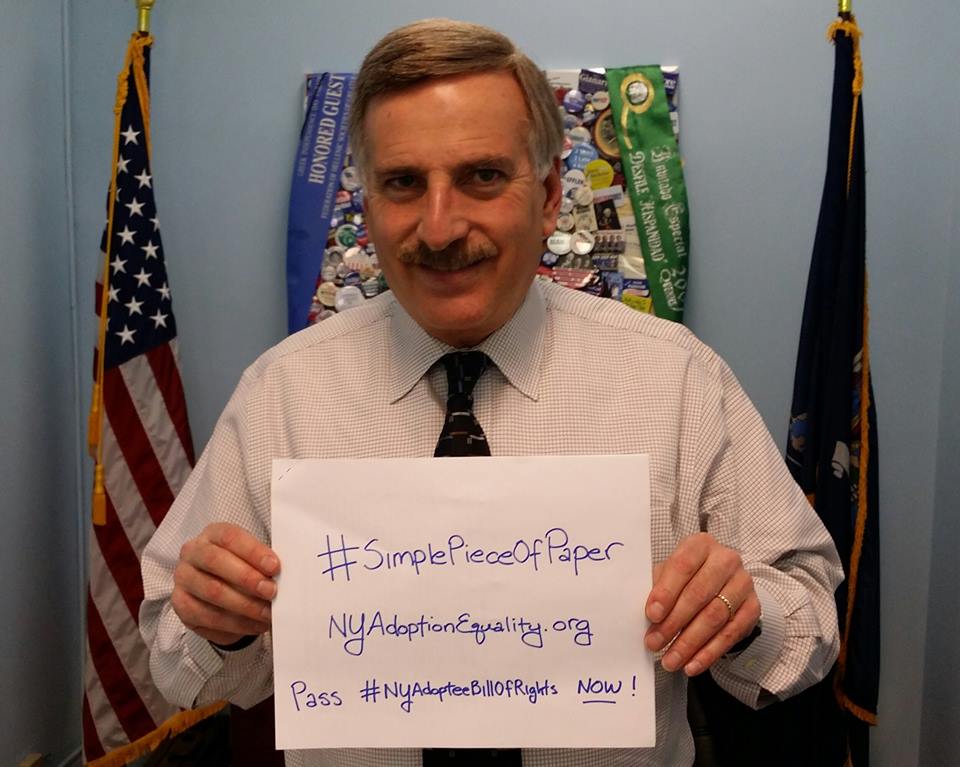
NY's Prime Sponsor: Assemblyman David Weprin

NY’s Prime Sponsor: Assemblyman David Weprin

If, like me, you are a New York adoptee, this is a great way to help increase the visibility of our cause. Please post your pic on my FB community page-Adoptees who have found their biological families.

Blessings for equal access,
V.L.

—————————————————-
Waving Backwards, a Savannah novel (SYP Publishing)
Imagine not knowing who you are,
until you find yourself in a statue 800-miles from home.
COMING TO Amazon/Kindle/Nook and a BOOKSTORE NEAR YOU JULY 2015
Uncensored Adoptees Tell Birth Mothers The Truth

As moderator of the Facebook page –Adoptees who have found their biological relatives, I ask members to comment on reunion-related questions. This engaged community shares with gusto and their answers give insight into the many feelings associated with abandonment, adoption and reunion.

adoptionLast week, I asked the following question.

If you could say one thing about adoption to your birth mother (without guilt or censorship) what would it be?

These heartfelt replies are a testament to the pain, healing and resilience of adoptees.

  • You have made me feel like an abortion come to life. You nearly destroyed me when I first found you and every interaction thereafter has been unbearably painful. I believe you are a frozen person, disassociated from your pain and I feel sorry for you that your life is full of lies and secrets and you will not come into the light.”
  • “One thing…..who’s my birth father? ….won’t tell any of us”
  • “I forgive you.”
  • “Just curious as to why you kept the 4 children you had after me. I’m not angry or bitter, just curious.. I’m not asking because I wonder what life would have been like with you either.. I’m curious by nature.”
  • “Without guilt, thank you, and I mean it. Uncensored… you suck, and I mean that too. But I feel guilty about feeling it!”
  • “I have had a wonderful live, but I missed you.”
  • “You used the care system to dispose of me, but I made so much more of my life thanks to my short time in adoption and foster care. Thank you for negating me to your whole entire family, and lying for over 20 years who my father is. I’ve let go of that never and continue to strive to be a better mother woman and human being than you ever could be.”
  • “It would be a question, not a statement. I would ask her if she ever thought about me.”
  • “Thank you for giving me a stable healthy life.”
  • “Thank you for healthfully bringing me into this world. Thank God you didn’t raise me. Why after 42 years do you still hold onto secrets?”
  • “I would tell her that I wish she could have kept me, she wanted to, but was forced to give me up. Sad.”
  • “My first mother and I have talked at length about my adoption and the events that lead up to it. A lot of illegal things were done and she was treated badly. I think the one thing I would say that I am not sure I have is, ‘I’m sorry those things were done to you.'”
  • “You made the best decision ever to put me up for adoption…it was done out of love.”
  • “I’m so glad we found each other, thank you for never giving up.”
  • “I would tell her to seek professional help for the pain she has from losing me at birth, for no other reason than I need my mom. I need that safe place to curl up in her arms, and let all the hurt and pain of the past 45 years out. And then finish healing together. Wishful thinking. I know.”
  • “Why? Why? Why? Why could you have given me to my birth fathers family instead of telling them I died?”
  • “You lied! You also kept a sister after you relinquished me. You hurt me.”
  • “Why would you still hide me from my family after all these years? I have not hid you from anyone in my family but if I did, how would that make YOU feel? I don’t think you realize how hiding my reality (and yours) just reinforces the feelings of being unworthy of acceptance. Still haunts me to this day.”

What would you say?  Share your thoughts in the comments below.
I asked the same question with regard to adoptive parents, and will share those answers this weekend.
Blessings for open, healing adoption dialogue,
V.L.

An ‘F’ Word to Feel Good About in the New Year

It came to me after spotting one of those cutesy postcards on Facebook that read, ‘we’re all faking it’. A epiphany of influential interactions flooded my head, followed by a vision of the most powerful F word to ever grace humankind. A word that has made kings of slaves and built a thousand empires. Fword

The word is FAKE.

As an international music journalist, I interviewed top artists of the late 1980’s and early 1990’s. From Aerosmith to Skynyrd, I picked the brains of the best. Later, as a documentation specialist in the tech world, I was surrounded by  a bevy of brilliant physicists. From rock stars to ion rockers, I viewed the success of these men and women in perpetual awe.  I mingled among them in a state of insecure impostering. After all, I was born, given away, re-placed and forced to figure out where I fit in.

During my very first national music interview with the late, great Joey Ramone, my voice cracked, and I giggled a lot. My hands shook as I settled in to an hour long conversation with the punk icon. Sizzling behind every word was my imposter voice. Who are you kidding? He’ll think you’re a groupie.  He didn’t, and the interview was brilliant, fun and launched my career. Before I knew it, record labels were calling on me every time a big act came through Boston. Still, I felt like a flounder flipping about in a dwindling puddle of made-up reality. Evaporation was imminent.

With my physicist colleagues, it was worse. I have a college education, but the terminology tossed about by these men and women was as foreign to me as a ride on the space shuttle. In fact, I went home after the first day on the job and cried. I was a scientific novice, and felt sure they would toss me out. I purchased a periodic table, learned atomic abbreviations and prayed, a lot!

As a kid, the feeling was the same. I was adopted. I knew nothing about my birth family. I pretended that I was like everyone else. But inside I felt made up. Despite the fact that my music and science careers came after I found my birth family. (Read how I found them in this post), I still assigned the source of my fake-dom to being adopted.

What I failed to examine as I trudged through the firestorm of adoptee insecurity were the stories of the rock stars I interviewed, and the scientists I worked with. If I could have tuned out my tenacious imposter’s voice for longer than a nano-second, I would have heard the universal message, “I’m faking it too.”

During an interview with singer Gary Cherone of the band Extreme, he told me about the first time he sang for his mother and grandmother.  He was so shy that he sang from inside the kitchen closet with the door closed. In his heart, Gary was insecure about his talent.

A physicist co-worker from overseas once shared with me his story of studying under the streetlight at the center of his town (because there was no other electricity) and despite being at the top of his field, wondered out loud if a man from such a humble beginning deserved success.

These men were not adopted, and yet they were faking or questioning their success. It never occurred to me that someone who always knew their bloodline could feel like a fake. Everyone appeared so solid, and confident. They were big, important people who wore success like a golden cloak of superiority.

Yet underneath, they questioned their family connections (blood or chosen), life choices, and career successes. Dear readers, in no way am I discounting the extra anxiety and loss of being adopted. If you have read my other blog entries, you already know my heartfelt belief that finding your family is essential for growth and peace. My New Year message to you is one of inclusion.

Knowing that everyone feels like a great big fake at sometime in their life goes a long way to settling in to become who you are meant to be. Feeling like a fake is the result of fear. Worrying about being found out for the authentic, learning, seeking and not so perfect human that you are is universal.  While I don’t recommend you sling the ‘F’ word around this year in an effort to even your human playing field. I do hope you will start 2015 on better footing by listening for the helpful (and humorous) ways your friends, colleagues, and fellow planet-dwellers admit that they too – are faking it.

Blessing for a year of revelations and improved self-worth,
V.L. Brunskill