Search Tip: Find an Adoption Reunion Search Angel

Searching for your birthfamily is time-consuming and costly. However, there are volunteers out there that will assist you with the process. They are called Search Angels.  Usually, adoptees or birthparents themselves, these volunteers offer guidance that can shorten your search by years.

sun dazed/Flickr.com

This search tip offers links to find a Search Angel, and advice on how to proceed once you do.

1. Get organized. Have all of the information you’ve gathered about your adoption ready. I often get email requests that are vague. To help,   I need the adoptees gender, plus date and place of birth. Once I have this, I can recommend specific search actions.

2. Find an angel.  Often the best place to find a reliable, useful angel is in reunion forums.  Search for local adoption reunion forums for your state as well. Also see the links listed at the end of this post.

A few national forums include:

3. Ask the search angel for references, or search  forums like those at adoption.com. Sign up for a free account to post an inquiry.  There is a current post on the support forum about a scam angel named Alex Shan.  Search your angels name in these forums, and Google their name to see if there are complaints.

4. Never share your address, or social security number with a search angel.

5. Ask about expenses. Angels are supposed to be free, but some ask to be reimbursed for travel.

6. Do not expect that a search angel will spend all of their time working on your search. Most offer advice, and tips for moving forward. Some will plug away at your search for years. Remember that a search angel is not a professional, they are volunteering to help you.

The sites below will help you find a search angel.  Of course, you should Google by state as well, (example- ‘Florida Adoption Search Angels’) since many volunteers work only in the state where they reside, or where they have search experience.

If you know of other Search Angel directories, let me know and I will add them.
Adoptee Search Tip: How Non-Identifying Information Identifies

Today, I want to explain the importance of obtaining a letter of non-identifying information from the agency that placed you. Of course, adoptees in search, must first figure out who handled their adoption. This could be  a lawyer, state agency, private agency, or religious organization.

GlasgowAmateur/Flickr.com

Do whatever it takes to find out which agency, lawyer, or placement provider handled your case. Ask every relative, dig through family files, the family bible, safe deposit boxes.  You might even consider volunteering to clean out your adoptive parents attic!

Once you know the agency that handled your transition, it is time to track down the current address, and contact information for that organization.  Once you have that, I recommend starting with a phone call, to ask about their policy for giving adoptees access to their  “non-identifying” information.

In most cases, agencies will provide you with a letter that includes some information on your birthfamily.  Often, you will have to make the request in writing, and there could be a fee.

You may wonder why you’d want a letter than lacks identifying information. Well, considering that you are starting at zero, this letter is a great starting point. You have no clue what your birthmother was interested in, if she was in school, what her job was, where she lived or whether or not your birth grandparents were aware of your birth.  All of this, and more is often included in a letter of non-identifying information.

When I was searching, I received my letter from the Children’s Aid Society in New York City.  My letter included the number of siblings my birthmother had, as well as the occupations of my uncles at the time of my birth.  It also revealed that she was from a “small town in Canada” and that her “father worked in a hardware/grocery store”.

Additional information revealed that my birthmother was a shy, timid girl, with blonde hair and brown eyes, and that she had no way to care for me, and gave me up so that I would have a “good family”.

While the information may seem vague, the clue that led me to my birthfamily was in that bare-bones information.  Also, tucked in my letter, was the only photo I have of me as a young infant. On the back of that photo, was a surname, one that I had heard all of my life.  My adoptive parents were told my birthname was Richards.  The photo confirmed this (as did a trip to the Birth Register books  at the NY Public Library).

I reread my letter a thousand times (0ver a 7 year period), checking and rechecking for clues, and just when I thought it was useless, my search angel asked me to read it again. I read it aloud to her, and she stopped me at the part that read, “One of your mother’s brothers was a wireless operator.”

My search angel asked me, “What’s a wireless operator?” I did not know, and she suggested that I contact the Federal Communications Commission (FCC)  in Washington, DC.  A very nice man at the FCC explained that a wireless operator in Canada would have required a license, and that I should contact the Canadian Communications Commission.

I called the CCC once, and hung up when a woman answered in French.  Later, I wrote a letter explaining that I had a medical issue, and that I was looking for a Richards male who was a wireless operator in eastern Canada during the year that I was born. I picked eastern Canada because I was born in New York.

I received a written reply in June of 1991.   There were only three Richards men who had wireless operator licenses the year I was born.  The man who wrote the reply, happened to know one of the Richards men. He wrote that  M. Richards still worked for the government, and provided me with his telephone number. M. Richards turned out to be my Uncle.

Every non-identifying letter is different. Some are  detailed, some vague, and some arrive with  secrets revealed, and even surprise photos.  There are social workers, lawyers and judges who recognize the significance of knowing your genetic history, and some will beef up non-identifying info with clues.

Get the request in as soon as possible, and make sure you check with the agency  for procedures.  Once you get your letter, look at occupations (especially those that require a license) and at schools.  Was your birthmother at an art school, nursing school, secretarial school?  How many siblings did she have? These are all revealing clues, that can narrow your search.

Of course, if you get your non-identifying information, and have no idea where to start, I am happy to give you a little advice. Feel free to email me at vbrunskill at gmail.com.

Happy hunting!

All rights reserved: Copyright 2012 Vickilynn Brunskill

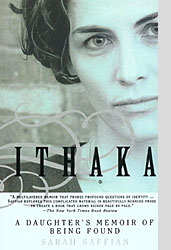
Book Notes: “ITHAKA” Reveals Importance of Adoption Search Process

I often tell adoptees that searching is as crucial a part of the wholeness process, as finding, and that they should keep it as hands-on as possible. The many stages of revelation during my own search, allowed me to grow and change along with information, as it was revealed.  Instead of a sudden reunion, my mind was readied (as much as it could be) for the reality of a second family. I was in charge of the unveiling process.

Last night, I finished reading the book, ‘ITHAKA’ by Sarah Saffian. Subtitled, “A Daughter’s Memoir of Being Found”, the book offers a unique perspective into what happens when the search is not controlled by the adoptee, and is instead a search FOR the adoptee by the birthparent.

I know many of you are thinking that this scenario is a dream come true. Well, it can be, but as revealed in this poignant non-fiction work, it can also be a life-altering shock.

In the book,  Saffian recalls the phone call that changed her life forever. Sarah’s birthparents were re-united after her relinquishment, and married. They searched for Sarah, found her, and called her.

Saffian discusses how she undertook some mock search steps after the call, to better understand what it would have been like if she had been the one searching.  A successful New York woman, with a solid adoptive family, she clearly enjoyed control over her destiny, until her birthparents called.

Writing letters to her birthparents for years before being reunited, she undertook a process of adjustment, not unlike that of an adoptee in search.  She needed those letters and time to reprogram her reality.  Saffian does a wonderful job of exploring the plethora of emotions, and adjustments required to accept a dual identity. I applaud her honesty, and highly recommend this book for all adoptees  and birthparents.

Life in Limbo: Encouragement for those in Search

WilsonB/Flickr.com

In all of us there is a hunger, marrow-deep, to know our heritage, to know who we are —and where we have come from. Without this enriching knowledge, there is a hollow yearning, there is the most disquieting — loneliness.”- Alex Haley – Roots

I share this quote today to encourage adoptees in search, and to remind everyone of the normalcy of the need to know.  You are the product of past generations, and deserve to know everything that went into the making of you.

As I work on my book, I often reflect on the past with disappointment. My formative  writing years and the idea of a writing career, started after I was reunited with my birth family. Before that reunion, my focus was clouded by a sense of incompleteness.  I was a stranger to everyone, even myself,  a blank slate,  looking, clinging and begging for a genetic map to guide me.

There is a sense of mourning that comes with wondering who I might have been by now, how many books I might have published, if only I was whole enough to begin writing novels earlier in life.

Many adoptees feel as if their lives are stalled,  in limbo, until they search. The search, even when unsuccessful is a vehicle to freedom. Finding is a miraculous rebirth, where two become one. Suddenly, the infant with one set of parents, is an identifiable part of the adoptee whose surroundings are a foreign landscape to which they have adapted.

Of course, much of the content in my book ‘Waving Backwards’ could not exist without the experience of searching seven years for my birthmother and another five for my birthfather.  The need to know was overwhelming and all encompassing, and those feelings deserved to be explored and shared.  So the very thing that held me back from finding my life’s passion, is also the thing that enables my first novel to exist.

Many adoptees are labeled angry or insensitive for demanding open records. If only we thought of their searches as essential to ignite the meaningful endeavors of their lives, perhaps we would not judge as harshly.