Printable Poster: Original Birth Certificate (OBC) Laws for Adoptees by State

I just discovered a handy printable guide to the rules in every U.S. state regarding access to original birth certificates.  Available at adopteerightscoalition.com, the chart/poster presents details on every U.S. state You can either download it, and view as a pdf file or print it.
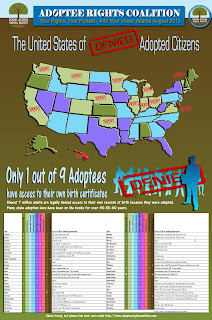
Adoptee Rights Coalition Poster

The Adoptee Rights Coalition is a group that “supports legislation that will give all adopted adults unconditional restored access to their own birth certificates.” The Coalition holds rallies across the county, and its site is chock full of information on  adoptee rights, and legislation.

If you’re interested in the cause of equal access for adoptees, there are several ways to get involved.  First,  consider attending the Adoptee Rights Demonstration scheduled for August 2013 in Atlanta, Georgia.  More details on this event will be posted at adopteerightscoalition.com as they become available.

Can’t make it to Atlanta? No problem, there are other ways to get involved. The Adoptee Rights Coalition also hosts writing campaigns “to inform all state legislatures of the urgency of unsealing our records to restore the equality of adoptees in the United States. ”

As with most non-profits, the group could also use financial donations to keep the cause alive.   There is a Paypal button on the website! For more ways to help, visit http://www.adopteerightscoalition.com/p/help-arc.html .
Civil rights should extend to all humans, and I am happy to focus on a group that is working  to assure that adoptees are finally recognized and reunited with their truth!

Blessings  for access and reunion,

Vicki-lynn Brunskill

Australia Apologizes for Forced Adoptions: America Next?

There has been quite a bit of adoption buzz this week on forced adoption practices in Australia during the 1950’s, 60’s and 70’s.  The news culminated with yesterday’s public apology by New South Wales Premier Barry O’Farrell.

ABC News Australia reports that O’Farrell’s apology was this:

“We are sorry you’ve had to wait for so long for this apology. We know that you live with the consequences of those practices every day.

We are sorry for the forced adoption practices that severed the fundamental life-giving bonds between mother and child.

We apologise to the mothers who were not asked or listened to and who were never given a choice about the future of their children. We apologise for making you feel ashamed and unfit to care for your babies.

We say sorry for treating you cruelly and insensitively when what you needed and deserved most was care and support.

To the women who have carried the pain of loss, grief and separation throughout your lives, we say sorry.”

Well said, but woefully late and inadequate, the apology has served a greater purpose, in revealing the dirty reality of many adoptions. The news coverage surrounding the apology is an excellent opportunity to educate the general public on the horrors faced by unwed pregnant mothers in the mid-20th century. Not just in Australia, but in America as well.

I recently blogged on the Dan Rather report “Adopted & Abducted” which revealed forced adoption practices in America. Yes, women in our country were also strapped to beds, so they would not attempt escape with their babies. Women in our country were also drugged so that they would never know the gender of their babies. Women in the USA also had their hands held while they were forced to sign adoption papers.

Children were stolen in America, just as they were in Australia.

When will America apologize? Since our adoption practices/laws are governed by state agencies, and most of the forced adoptions of the 50’s-80’s were handled by religious agencies, don’t hold your breath!

Rather than an apology, my wish for all members of the adoption triad, whether forced or voluntarily separated, is for every state to open records for adult adoptees in search. Adoptees did not sign a relinquishment form, and it should be the  civil right of every American adoptee to know their ethnicity, medical history, and roots.

So forget the apology America, we want justice.

Blessings for a speedy reunion,

Vicki-lynn

Rhode Island Law Leads to Reunion

Sharing a wonderful Rhode Island reunion story!
When states open records, miracles happen.
Here’s to more miracles!

Mother, son reunited after more than 40 years apart – WAFF-TV: News, Weather and Sports for Huntsville, AL.

In March,  I blogged about the Rhode Island law that allows for access to original birth certificates. This is an option for those over 25 years old.  To learn the process  for requesting RI adoption records – see the entry;
RI Adoptees over 25 Years Allowed Original Birth Certificates

Have a RI reunion story to share?
Please comment below or email me at vbrunskill@gmail.com

Blessings for your own reunion miracle,

Vicki-lynn

Hawaii Adoption Reunion Resources

In response to a reader’s question, I have compiled a list of Hawaiian adoption reunion resources.

The good news for adoptees who were born in Hawaii, is that you can request your adoption records.  According to HawaiianRoots.com, ” new adoption notification law allows adults to learn of their birth parent unless the parents have indicated to the court that they do not wish to be contacted. ”

HawaiianRoots.com suggests the following contacts for requesting information. I recommend that you give them a call to confirm, as this information could change.

Oahu by mail: Adoption RecordsFamily Court, First Circuit CourtP.O. Box 3498Honolulu, HI 96811-3498
Oahu in person: 9 a.m. to 1 p.m. Mon-FriCourt Management Services BranchKaahumanu Hale, Second Floor777 Punchbowl StreetHonolulu, HI
Maui, Molokai, and Lanai: Adoption RecordsFamily Court, Second Circuit2145 Main Street, Suite 226Wailuku, Maui 96793
Big Island: Adoption RecordsFamily Court, Third Circuit345 Kekuanaoa Street, Room 40Hilo, Hawaii 96720
Kauai: Adoption RecordsFamily Court, Fifth Circuit3059 Umi StreetLihue, Kauai 96766

They also offer a clue for adult adoptees looking for natural parents: “Birth certificates are altered to reflect the names of the adopted parents but newspaper vital record listings will show the names of birth parents.”  This means that searching the local newspaper archives could help you find your birth name.

Below is  the applicable adoption records law:

Mutual Access to Identifying Information
Citation: Rev. Stat. § 578-15

An adoptee who is age 18 or older may submit a written request to the family court for inspection of adoption records. Such records will be released unless the birth parents have filed a confidentiality affidavit. Such affidavits may be renewed every 10 years. The adoptee may submit an affidavit person consenting to the inspection of records by the birth parents

The form to request your information is offered in PDF format at the link below. It also gives addresses for mailing.
http://www.state.hi.us/jud/Oahu/Family/1F-P-767request.pdf

TIP: For those searching in any state,  use the link below to search for adoption records and reunion laws by state.
http://www.childwelfare.gov/systemwide/laws_policies/state/index.cfm?event=stateStatutes.showSearchForm

In addition to formally requesting your records, Hawaiian adoptees should search and register for the reunion registries and forums below.

I cannot possibly find every resource out there, so if you know of other Hawaii resources, please comment on this post, or email me at vbrunskill@gmail.com.

Ke Akua(God) Ho’omaika’i(Bless) Oe(You)!
Vicki-lynn

Adoptees Beware: Religious Agencies Changed Birth Dates & Data

Last week, I was mulling over the relinquishment of the main character in my novel ‘Waving Backwards.’ The feelings and difficulties of being an adoptee in search are easy for me to explore, since I found my birth family after a 12 year search. However, the  birth mother’s experience is somewhat of a mystery  to me.

As I considered the relinquishment scenes for my book, I was blessed to turn on the TV to find Dan Rather reporting about forced adoption in the 60’s & 70’s. His report titled “Adopted or Abducted” opened my eyes to the questionable practices employed by many adoption agencies during the adoption boom.

During the 60’s & 70’s, waves of families moved to suburban neighborhoods, becoming what we now know as the middle class. At that time, social standing and reputations were extremely important.

According to Rather’s report on AXS TV, the increased focus on social standing, coincided with a change of attitudes among young people about sex, dating, and experimentation. Therefore, the rate of unwed pregnancies rose.

Families eager to protect their daughter’s reputations (and their own) often sent these unwed teens away to have their babies. Maternity homes were popular, and many were run by Catholic organizations.

Rather’s report focuses on the experiences of birth mothers sent to live in maternity homes, and how they were forced to give away their babies. Birth mothers were often tricked or forced into signing relinquishment papers. Some were even told that their babies had died.

The part of the report that is most important to those of you in search is the revelation that agencies (like Catholic Charities) often changed the identifying information in adoption records. They did this, so that the birth mother would never be able to locate her child. They also changed the nationalities of children, to better match the nationalities of their adoptive families.  Thereby creating a perfect fit by falsehood.

If  you are searching for your birth family, this could be a crucial fact. If the agency that placed you changed your birth date, your internet searches could be omitting crucial information.  When you search online or register for reunion registries, I suggest using the year and state of your birth, in addition to the city and date of birth that appears on your amended birth certificate. Someone could be looking for you with information that is different than the info you have.

Troy Dunn, AKA The Locator, who was interviewed for the report, has heard from thousands of birth mothers who were forced to give up babies. He has also found birth date changes to be  commonplace. (Sickening, I know.) Dunn cited Catholic Charities as one of the biggest culprits. Therefore, if you were placed by Catholic Charities, I would question every bit of information provided in a letter of non-identifying information.

I highly recommend that birth mothers and adoptees view the show. Birth mothers may find some solace in knowing that they are not the only ones who had their babies stolen, and adoptees may find a new perspective on the horrible process, and what it means to their searches.

Blessings,
Vickilynn

Adoptee Rights Demonstration Today in Chicago

If you are in the Chicago area, this is the place to meet like minded adoptees interested in open records for all!

K.'s avatarKaren Pickell: Between

Adoptee Rights CoalitionThe Adoptee Rights Coalition has organized a demonstration to take place today during the National Conference of State Legislators in Chicago. Specifically, they will be trying to open the legislators’ eyes to the plight of adult adoptees in forty-four states who are not allowed to have a copy of their own original birth certificates.

What is an “original birth certificate?”

Many people who are not intimately affected by adoption do not realize that adopted people have two different birth certificates. Whenever a child is born, a birth certificate is issued to legally record that birth. We all know that, right? At minimum, the birth certificate lists the baby’s name and the name of the child’s mother.

If that baby is later adopted, a new birth certificate is issued which lists the child’s adoptive name, and his adoptive parents’ names as mother and father. The original birth certificate–the one that lists…

View original post 956 more words

Step-by-Step Adoptee Search Advice from About.com

While there is no full proof method for finding your birth family, About.com Guide Kimberly Powell has done a nice job of breaking down the initial steps for searching. In the article “Adoption Search -Steps for Locating Adoptees, Birth Parents, and Adoption Records“, Powell offers seven steps to take once you decide to search.

catlovers/Flickr.com

The suggested search steps include:

  1. Write down everything you know, or ever heard about your adoption, birth family, and nationality. Nothing is unimportant! Think of what your relatives have said about your adoption.
  2. Interview your adoptive parents for information. Again, write it all down. Even the tiniest detail may be important.
  3. Gather documents. The article suggests that you ask your birth parents, which is of course a tough step for many adoptees, as they choose not to include the adoptive parents in their search. The article also suggests that you obtain your original adoption decree, amended birth certificate, and petition for adoption. Some states will allow you access to these items (all allow the amended birth certificate). However, in some states the adoption decree can only be requested by the adoptive parents.
  4. Request non-identifying information. I have two posts on this that should be helpful.Letter for Adoptees To Use When Requesting Non-Identifying Information
    Adoptee Search Tip: How Non-Identifying Information Identifies
  5. Register in every reunion registryyou can find. Make sure to look for state registries.  Another AdoptionFind post offers more on these registries and how to find them.Searching Reunion & Mutual Consent Registries
  6. Join a support group. The information shared in these groups, mailing lists and forums is abundant and worthy of your time.
  7. The final suggestion in About.com’s article is to think about using a Certified Intermediary (CI).  The only problem with this is that not all states offer this search assistance. Google on your state to see if they do.

Be sure to read the full article at Adopt.com, as it offers many links to additional information on Search Angels, the I.S.S.R national registry, and to a people search guide.  Although, none of these steps guarantees that you will find your birth parents names (as suggested at the start of the article), the information gathered with these steps may lead to your ultimately finding your family.

Personal note: I did not know my birth mother’s name until after I found my biological Uncle. He told me her name, so that it was not her full name that was crucial. It was my birth surname that aided in the search.

I found my birth name in the NYC Birth Register books. These are housed at the NY Public Library.  Check your city library to see if they have similar books, which break down births by date, and in my case, city Burroughs.  You can then look for the correct gender, and know that one of those kids is you! 

Your surname is the holy grail!

Kansas Man Finds Birth Mother After Reading about New Adoption Records Law

A recent article from The Witchita Eagle, reports on 57-year-old Bob Fowler’s reunion with his birth mother in Kansas, after he read an article about the  availability of non-certified, pre-adoption birth certificates for adoptees in Kansas.

According to the Kansas Historical Society, “Adoption records are open to adoptees 18 years and older. The adoptee has to request the records from the Clerk of the District Court’s office in the county where the adoption occurred. An adoptee can obtain their birth certificate. Proof of identity is required. Descendants of the adoptee cannot view the records. For information about obtaining pre-adoption birth certificates please see the Office of Vital Statistics web page.”

Fowler’s story of reunion is unique because he was never really interested in finding his birth mother. He had a caring adoptive family, and a generally happy life. According to the article, his wife suggested he look for his birth mother saying,

“You might have a hole in your heart you don’t even know about.”

For his birth mother, Cheryl Allenbrand, the timing could not have been better. It turned out that Allenbrand, who  gave Fowler up for adoption when she was only 15-years-old, had buried all three of the biological children whom she raised.  Thoughts of the child she gave up haunted her.
This is a happy adoption reunion story worth reading.  It is also a reminder, that even adoptees who think they do not need to know their biological family, often find comfort and wholeness in  reunion.
The full story is here: Mother, child reunion took 57 years.

Illinois Adoptee Access to OBCs Stands, Additional Access Stalls

Recently,the St. Louis Post-Dispatch published an article titled, Illinois adoption records legislation fails amid abortion debate. The article discussed the failure of open records adoption legislation in Illinois. Since I recently  blogged on the success of the ‘ OBC (Original Birth Certificate) adoptee access law’ that passed in 2010 , the article was confusing, and as it turns out, a tad misleading.

Sara Feigenholtz

To assure that adoptees understand the status of records access in Illinois, I contacted the office of Illinois State Rep. Sara Feigenholtz.  Feigenholtz, an adoptee herself, sponsored the adoption legislation in question.

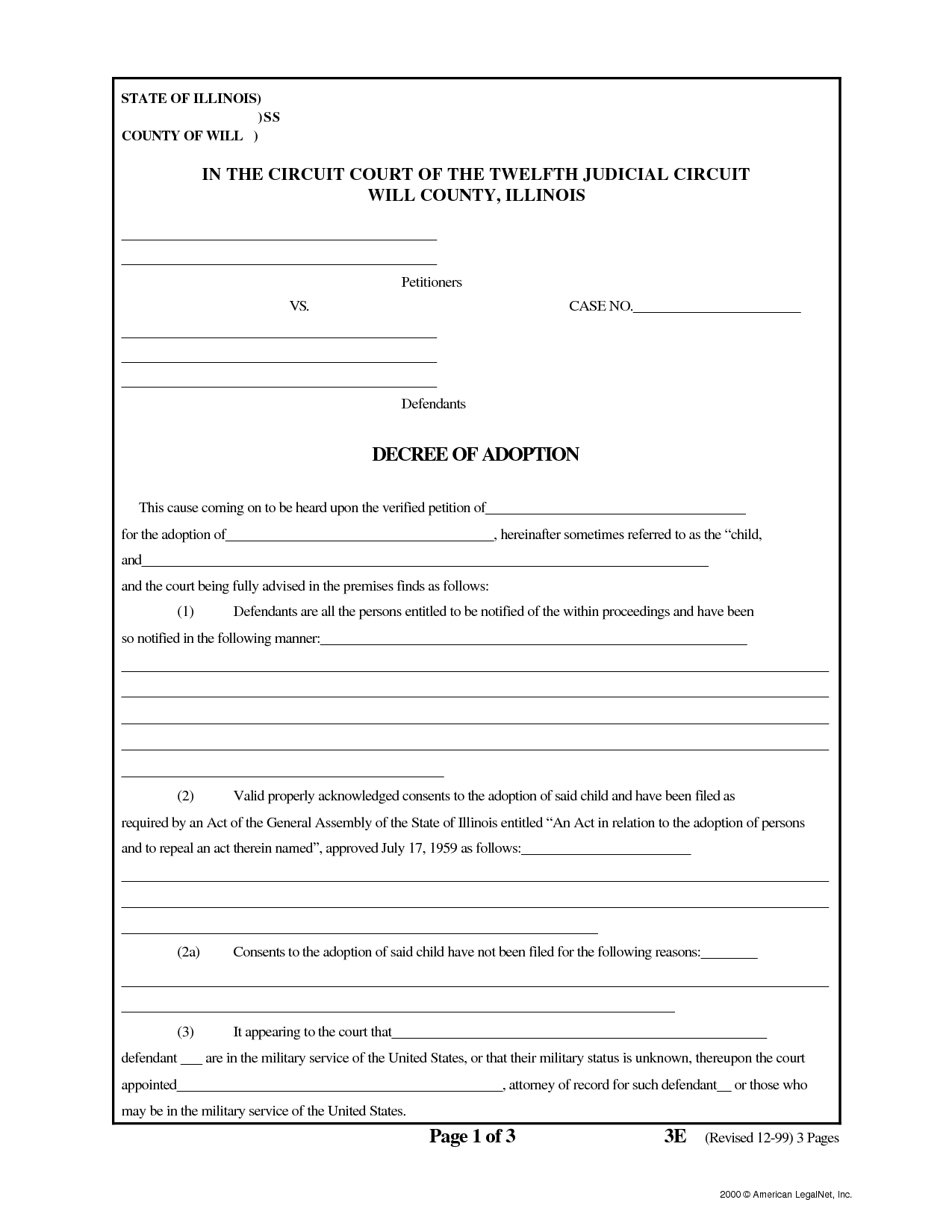
A representative from her office  contacted me and explained that the St. Louis Post-Dispatch article refers to an entirely separate piece of proposed legislation.  The legislation, which is currently “postponed for consideration” refers to access to the adoption decree.  An adoption decree is a document, filed at the time of the adoption. This  is a sealed court document. However, adoptive parents or the ‘attorney of record’ can access this document at anytime, without any special cause or reason.

The new bill, proposes that adult adoptees be allowed access to the adoption decree if they:

  • Have their Original Birth Certificate, with no redacted info (adoptees not subject to denial of information)

OR

  • Have a letter from the state saying that their original birth certificate could not be found.

Illinois adoption decree

While the new bill might be controversial, because of personal and potentially damaging information that could be included on the decree (i.e. a birthmother’s unfit status, criminal record,  drug use), this is NOT the reason the bill failed, after the last round of discussion.

Instead, debate on this bill was about abortion.  Lobbyists claimed (and some state reps agreed) that if a birthmother thinks the adoptee will have access to the adoption decree, they are more likely to choose abortion.

Hello? First of all, adult adoptees already have access to their original birth certificates in Illinois. Secondly, adoptive parents are already granted access to the document. So, if an adult adoptee asks their adoptive parents to help out, they can already get this document. Plus, the bill would not allow adoptee’s access to the decree, if the birthmother has asked for a “denial of information’ or to “opt out” of contact.  So this legislation makes absolutely zero change to a birthmother’s  right to confidentiality.

Abortion rates have nothing to do with the proposed legislation. Birdbrain lobbyists should actually think before they squawk!

You can  follow the progress of this bill at the Illinois General Assembly site or you can visit Illinois State Rep. Sara Feigenholtz‘s site to learn more.

States Where Adoptees Can Access Birth Certificates

Below is an alphabetical list of the states that offer some type of access to birth records, along with URLs (addresses) for the required forms.  Keep in mind, that the laws change. All links are up to date as of this posting.

  • Alaska: Records open to adult adoptees age 18 or older. Bureau of Vital Statistics, Alaska Department of Health and Social Services, PO Box 110675, Juneau, AK 99811-0675
  • Colorado: Records are open for adoptions finalized between July 1, 1951 and June 30, 1976 or after 1999, unless the birthparent has filed a disclosure veto. Additional information and application is here- http://www.cdphe.state.co.us/certs/adoption.html
  • Indiana: Records open for adult adoptees over the age of 21 for adoptions completed prior to January 1, 1994. Identifying information is released only of both the adoptee and the birth parent (named on birth certificate) file a written consent with the registry. Records prior to 1940 are released without court order or mutual consent. Consent form available here: http://www.in.gov/isdh/20371.htm
  • Illinois: People  born on or after Jan. 1, 1946 may obtain their non-certified birth certificate. Adopted or surrendered adults can request a non-certified copy of their original Illinois birth certificate. Only people who are at least 21 can receive a non-certified copy of their original birth certificate.
    http://www.idph.state.il.us/vitalrecords/vital/adoptbroch.htm
  •  Kansas: records are open for adult adoptees over the age of 18. Records must be requested through the Clerk of the District Court’s office in the county where the adoption took place. Information on birth certificate requests can be found here: http://www.kdheks.gov/vital/adoption_before_adoption.html
  • Montana: Adoptees whose adoption took place on or before 7-1-1967 can obtain a copy of the original birth certificate. Adoptions finalized between 7-1-1967 and 9-30-1997 require a court order. Adoptions finalized on or after 10-1-1997, can obtain a copy of the original birth as long as they are 18 and the birth parent has not requested non-disclosure. Request forms are here: https://dphhs.mt.gov/certificates/ordercertificates.shtml

For some adoptees in these states, information gathering starts with a great leap forward!  If you have additional questions on how to request your records, call the Bureau of Vital Statistics for the state where you were born/adopted.

Ask them what the procedure is for requesting your original birth certificate and any other information held in your adoption file. If they are clueless, and you know the agency that placed you for adoption, call them and ask for more information.