New York Times on Dark Side of Adoption Info on Internet

In a recent article, “Internet Use in Adoptions Cuts 2 Ways” New York Times reporter Ron Nixon discusses a report by the Evan B. Donaldson Adoption Institute, a nonprofit organization working to change adoption policy in America. 3094227198_866aac21d5_z

The report (released today) is the culmination of a three-year research project by the Institute on how the Internet and social media have altered the adoption landscape.

Despite the group’s active support of open-records for all adult adoptees, the report presents much more than happy reunion stories. It also delves into the devilish character of on-line adoption agencies, and the fraud that is often perpetuated by them.  The report also discusses why access to online information is not always positive for underage adoptees, especially in cases where an abused child is found by a birth parent.

I look forward to reading the full report which is available here: http://www.adoptioninstitute.org/publications/2012_12_UntanglingtheWeb.pdf

Blessing for reunion,
Vicki-lynn

Video News: Rhode Island Law Leads to Adoption Reunion

Eerily similar to my own reunion at Boston’s Logan Airport in 1992, this NBC news report reminds us why state adoption laws must be changed. Open records and access for all adult adoptees, will only be possible when state legislators cut through the red-tape, and change outdated adoptions laws.

Today. most adoptions are open. All parties enter an adoption agreement with identities revealed, nationalities intact and birthday’s remembered. In the 1950’s. 60’s and 70’s, unwed pregnancy was viewed as a sin against God, family and society. The children placed during those decades are now adults  in a wholly different world, and state laws should reflect the new culture of acceptance, genetic importance, and basic human rights.

Bravo, to Rhode Island for opening its adoption records to allow for this wonderful reunion.

To learn how to access your RI adoption records, check out the post ‘RI Adoptees over 25 Years Allowed Original Birth Certificates.’

Blessings that all states see the light, and open our records,

Vicki-lynn

Don’t Miss the Movie- “Adopted: for the Life of Me”

Today, I am sharing a link to the heartbreaking trailer for the movie “Adopted: For the Life of Me”. The movie aired on PBS, and while there are no future airings currently listed on the PBS site, you can purchase the DVD here.

When you visit filmmaker Jean Strauss’ site, be sure to read about her upcoming movie project (she needs moola to complete it), and about her significant work as an advocate for adoptee rights.

Jean Strauss

If Jean’s name sounds familiar, it is probably because she wrote a great search & reunion book titled,  “Birthright: the Guide to Search and Reunion”.

The film previewed in this trailer, explores the lifelong affects of never knowing your real name, heritage, or medical information. It presents the stories of real people, who late in life, are still living in the darkness of sealed records.

http://www.adoptedforthelifeofme.com/

Blessings to know your name at last,

Vicki-lynn

Printable Poster: Original Birth Certificate (OBC) Laws for Adoptees by State

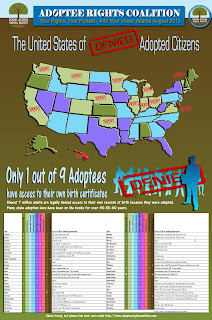
I just discovered a handy printable guide to the rules in every U.S. state regarding access to original birth certificates.  Available at adopteerightscoalition.com, the chart/poster presents details on every U.S. state You can either download it, and view as a pdf file or print it.

Adoptee Rights Coalition Poster

The Adoptee Rights Coalition is a group that “supports legislation that will give all adopted adults unconditional restored access to their own birth certificates.” The Coalition holds rallies across the county, and its site is chock full of information on  adoptee rights, and legislation.

If you’re interested in the cause of equal access for adoptees, there are several ways to get involved.  First,  consider attending the Adoptee Rights Demonstration scheduled for August 2013 in Atlanta, Georgia.  More details on this event will be posted at adopteerightscoalition.com as they become available.

Can’t make it to Atlanta? No problem, there are other ways to get involved. The Adoptee Rights Coalition also hosts writing campaigns “to inform all state legislatures of the urgency of unsealing our records to restore the equality of adoptees in the United States. ”

As with most non-profits, the group could also use financial donations to keep the cause alive.   There is a Paypal button on the website! For more ways to help, visit http://www.adopteerightscoalition.com/p/help-arc.html .
Civil rights should extend to all humans, and I am happy to focus on a group that is working  to assure that adoptees are finally recognized and reunited with their truth!

Blessings  for access and reunion,

Vicki-lynn Brunskill

Australia Apologizes for Forced Adoptions: America Next?

There has been quite a bit of adoption buzz this week on forced adoption practices in Australia during the 1950’s, 60’s and 70’s.  The news culminated with yesterday’s public apology by New South Wales Premier Barry O’Farrell.

ABC News Australia reports that O’Farrell’s apology was this:

“We are sorry you’ve had to wait for so long for this apology. We know that you live with the consequences of those practices every day.

We are sorry for the forced adoption practices that severed the fundamental life-giving bonds between mother and child.

We apologise to the mothers who were not asked or listened to and who were never given a choice about the future of their children. We apologise for making you feel ashamed and unfit to care for your babies.

We say sorry for treating you cruelly and insensitively when what you needed and deserved most was care and support.

To the women who have carried the pain of loss, grief and separation throughout your lives, we say sorry.”

Well said, but woefully late and inadequate, the apology has served a greater purpose, in revealing the dirty reality of many adoptions. The news coverage surrounding the apology is an excellent opportunity to educate the general public on the horrors faced by unwed pregnant mothers in the mid-20th century. Not just in Australia, but in America as well.

I recently blogged on the Dan Rather report “Adopted & Abducted” which revealed forced adoption practices in America. Yes, women in our country were also strapped to beds, so they would not attempt escape with their babies. Women in our country were also drugged so that they would never know the gender of their babies. Women in the USA also had their hands held while they were forced to sign adoption papers.

Children were stolen in America, just as they were in Australia.

When will America apologize? Since our adoption practices/laws are governed by state agencies, and most of the forced adoptions of the 50’s-80’s were handled by religious agencies, don’t hold your breath!

Rather than an apology, my wish for all members of the adoption triad, whether forced or voluntarily separated, is for every state to open records for adult adoptees in search. Adoptees did not sign a relinquishment form, and it should be the  civil right of every American adoptee to know their ethnicity, medical history, and roots.

So forget the apology America, we want justice.

Blessings for a speedy reunion,

Vicki-lynn

Adoptees Beware: Religious Agencies Changed Birth Dates & Data

Last week, I was mulling over the relinquishment of the main character in my novel ‘Waving Backwards.’ The feelings and difficulties of being an adoptee in search are easy for me to explore, since I found my birth family after a 12 year search. However, the  birth mother’s experience is somewhat of a mystery  to me.

As I considered the relinquishment scenes for my book, I was blessed to turn on the TV to find Dan Rather reporting about forced adoption in the 60’s & 70’s. His report titled “Adopted or Abducted” opened my eyes to the questionable practices employed by many adoption agencies during the adoption boom.

During the 60’s & 70’s, waves of families moved to suburban neighborhoods, becoming what we now know as the middle class. At that time, social standing and reputations were extremely important.

According to Rather’s report on AXS TV, the increased focus on social standing, coincided with a change of attitudes among young people about sex, dating, and experimentation. Therefore, the rate of unwed pregnancies rose.

Families eager to protect their daughter’s reputations (and their own) often sent these unwed teens away to have their babies. Maternity homes were popular, and many were run by Catholic organizations.

Rather’s report focuses on the experiences of birth mothers sent to live in maternity homes, and how they were forced to give away their babies. Birth mothers were often tricked or forced into signing relinquishment papers. Some were even told that their babies had died.

The part of the report that is most important to those of you in search is the revelation that agencies (like Catholic Charities) often changed the identifying information in adoption records. They did this, so that the birth mother would never be able to locate her child. They also changed the nationalities of children, to better match the nationalities of their adoptive families.  Thereby creating a perfect fit by falsehood.

If  you are searching for your birth family, this could be a crucial fact. If the agency that placed you changed your birth date, your internet searches could be omitting crucial information.  When you search online or register for reunion registries, I suggest using the year and state of your birth, in addition to the city and date of birth that appears on your amended birth certificate. Someone could be looking for you with information that is different than the info you have.

Troy Dunn, AKA The Locator, who was interviewed for the report, has heard from thousands of birth mothers who were forced to give up babies. He has also found birth date changes to be  commonplace. (Sickening, I know.) Dunn cited Catholic Charities as one of the biggest culprits. Therefore, if you were placed by Catholic Charities, I would question every bit of information provided in a letter of non-identifying information.

I highly recommend that birth mothers and adoptees view the show. Birth mothers may find some solace in knowing that they are not the only ones who had their babies stolen, and adoptees may find a new perspective on the horrible process, and what it means to their searches.

Blessings,
Vickilynn

Mapping out Memories: Using Google Earth to Find Family

According to a March 2012 report in Time Magazine, an Indian man named Saroo Brierley, who was adopted by Tasmanian parents, and lives in Australia, recently found his birthfamily using Google Earth.

Google Earth is a free application, that can be downloaded at Google.com/earth. The application allows users to take virtual tours anywhere in the world.  With amazing clarity, Google Earth lets you explore buildings, imagery, landscapes, waterways, etc.

Brierley left India at five-years-old, and had memories of begging on the streets with his brother. He also had some memory of landmarks that played a prominent role in his childhood. It was these tidbits of memory that had him zooming in and out on Google Earth for ten years, looking for a village that matched his age-washed memories.

He was successful. Brierley found the village, and his birthfamily. He was reunited with them in February of 2012. While Brierley says that communication is difficult, his reunion seems to be a happy one. According to the Time article, Brierley is even thinking of making his story into a movie.

While I cannot imagine that there are many instances where Google Earth is the best search tool on the Web. Brierley’s success does make a point about perseverance, and the crucial step of mapping out your memories.

If you have any memory of your birth family, no matter how vague, you need to write it down. Be as precise as possible with your list. List things as silly as “I had a pink teddy bear” and as identifying as “I heard a train go by everyday.”

By writing down your memories, and those of your family members, you may find clues that will help to narrow your search.  Interview your adoptive parents, and siblings, aunts and uncles, cousins. Every memory is another pin on the map that will eventually lead to your birth family.

Adoptee Rights Demonstration Today in Chicago

If you are in the Chicago area, this is the place to meet like minded adoptees interested in open records for all!

K.'s avatarKaren Pickell: Between

Adoptee Rights CoalitionThe Adoptee Rights Coalition has organized a demonstration to take place today during the National Conference of State Legislators in Chicago. Specifically, they will be trying to open the legislators’ eyes to the plight of adult adoptees in forty-four states who are not allowed to have a copy of their own original birth certificates.

What is an “original birth certificate?”

Many people who are not intimately affected by adoption do not realize that adopted people have two different birth certificates. Whenever a child is born, a birth certificate is issued to legally record that birth. We all know that, right? At minimum, the birth certificate lists the baby’s name and the name of the child’s mother.

If that baby is later adopted, a new birth certificate is issued which lists the child’s adoptive name, and his adoptive parents’ names as mother and father. The original birth certificate–the one that lists…

View original post 956 more words

Adoptees Use DNA Testing to Find Relatives

When I was searching for my birthfather, there were two possible culprits. My birthmother was a virgin when she arrived in the USA, and as naive as they come.  She met a nice man through a cousin, and he asked her to take a stroll on a NY beach.  During this walk, he raped her.

After her heart and trust was stolen, she decided that no man would ever take advantage of her again.  She had been attracted to an Army man, who wooed her endlessly, and after the horrible beach incident, she decided to pursue a relationship.
ynse/Flickr.com

So when she found out she was pregnant, she was not sure who my father was.  This left me with the difficult task of figuring it out. I found the date rapist first. He was actually a nice old guy, and swore that while he had dated my birthmother, there was no rape.  He had heard she was pregnant, and wondered if he might be a father.

When I found him, we had DNA testing done, and the negative result was heartbreaking, as he was truly tickled to have a newfound daughter.  We used the Fairfax Identity Lab.  I then went on to find my real birthfather, and he never wanted DNA testing. I knew he was the one, and therefore it was not necessary.

While DNA played a factor in my search, it was not the clue that opened the door to my identity. To find my birthmother and both father suspects,  took 13 years of pretty hard searching. Today, I am amazed at the level of identity and at the specific surnames that can be found through the process.

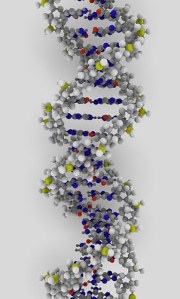
A New York Times article from January of this year, tells how adoptee Khrys Vaughan found her distant cousins using a DNA testing company, that not only provided her genetic countries of origin, but also gave her the names and email addresses of distant cousins.

The article suggests that testing can cost anywhere from $99 to more than $500.  Most of the companies I found are in the $300 range.  While I do not know anything about the reliability of these companies, the Times article mentions two testing companies; Family Tree DNA and 23andMe, claiming that “they  have databases that contain samples from 350,000 and 125,000 people.”  Those are pretty good odds for a match.

Note: Companies are competing for your DNA dollars. They do NOT share databases, so you might want to be tested by more than one.

My concern with these DNA companies is of course, accuracy. I had the same concerns back when I used DNA to confirm my birthfather’s identity.  However, I believe that the process has come a long way, and for those who have tried every other search avenue,, this could at least fill in the blanks as far as your real nationality.

Tread carefully, and ask around before coughing up the cash. I have added links to the two companies mentioned in the article. I may even give this a try in my effort to find my adoptive brother’s family. Of course, if I do, I will report my findings here.

Happy hunting and blessings,

Vicki-lynn

Are You a Missing Person?

A 35-year-old adoptee named Steve Carter got the shock of his life, when he decided to search for information regarding his birth.

Adopted at the age of four, from a Hawaiian orphanage, Carter came across the story of an adoptee who discovered that she had been kidnapped, and was adopted illegally.  His intuition kicked in, and Carter decided to look around some missing kid sites.

Carter found the site, MissingKids.com, did a search or two, and found an age-progressed photo that was his spitting image.

Sadly, his birthmother is also missing, and seems to have been on the run with him as a baby. She was later put into a psychiatric ward, and eventually disappeared from the system.

You can read more about Carter’s story at The Blaze.com and at The New York Daily News.

The moral here is to trust your instinct.

I have often wondered about a couple in my neighborhood who adopted their white, newborn babies  lickety split.  The adoptive mother claims, “we got each of our kids in less than a month.” When I asked her if she thought this strange, she did not even flinch.  Bought? Kidnapped? Luck?

If you were placed with your adoptive family later in life, or have a feeling that something does not gel, go to the missing kids website and take a look.  You might save someone from a lifetime of unimaginable heartbreak.